BRIGHT-RED BLEEDING
Blood on paper, in the bowl or on the stool surface should be assessed, especially when persistent or recurrent.
Haemorrhoids are normal vascular cushions. Treatment may be needed when they enlarge or prolapse and cause bleeding, discomfort, pain or hygiene difficulty. The appropriate method is selected after examination, not by grade alone.
Примечание: навигация по странице доступна на русском языке. Подробный медицинский текст этой специализированной страницы пока отображается на английском.
Selection depends on bleeding, degree of prolapse, the external component, previous treatment, bowel function and the patient's priorities. The aim is to balance symptom control, recovery and recurrence risk.
Symptoms may resemble other anal, rectal or colonic conditions. Diagnosis is based on history and examination, often including inspection, digital examination and anoscopy.
Blood on paper, in the bowl or on the stool surface should be assessed, especially when persistent or recurrent.
Tissue protruding during a bowel movement that returns spontaneously or needs manual reduction.
Moisture, mucus, itching or difficulty cleaning may accompany prolapse.
Sudden severe pain with a firm lump may indicate a thrombosed external haemorrhoid.
Bleeding should not automatically be attributed to haemorrhoids. A change in bowel habit, unexplained weight loss, anaemia or a family history of colorectal cancer may require further investigation and, in selected cases, colonoscopy.
Treatment is stepwise. It begins with bowel-habit optimisation and, when needed, progresses from office treatment to tissue-preserving procedures or excisional haemorrhoidectomy.
Fibre, fluids and constipation management form the basis of treatment. Topical preparations may provide temporary relief but do not correct prolapse.
An office treatment that interrupts blood flow to selected internal haemorrhoidal tissue, which then shrinks.
Intratissue laser energy is used to promote shrinkage and fibrosis of haemorrhoidal tissue without wide excision.
Controlled intratissue thermocoagulation of an internal haemorrhoid with a fine radiofrequency probe, aiming for shrinkage and fibrosis without anoderm excision.
Doppler-guided ligation of haemorrhoidal arteries and, when prolapse is present, mucosal lifting with mucopexy.
Excisional haemorrhoidectomy for extensive mixed disease, using an instrument that combines tissue division and haemostasis.
Educational anatomical and clinical images. Some images contain surgical content. Sources and permissions are identified where required.
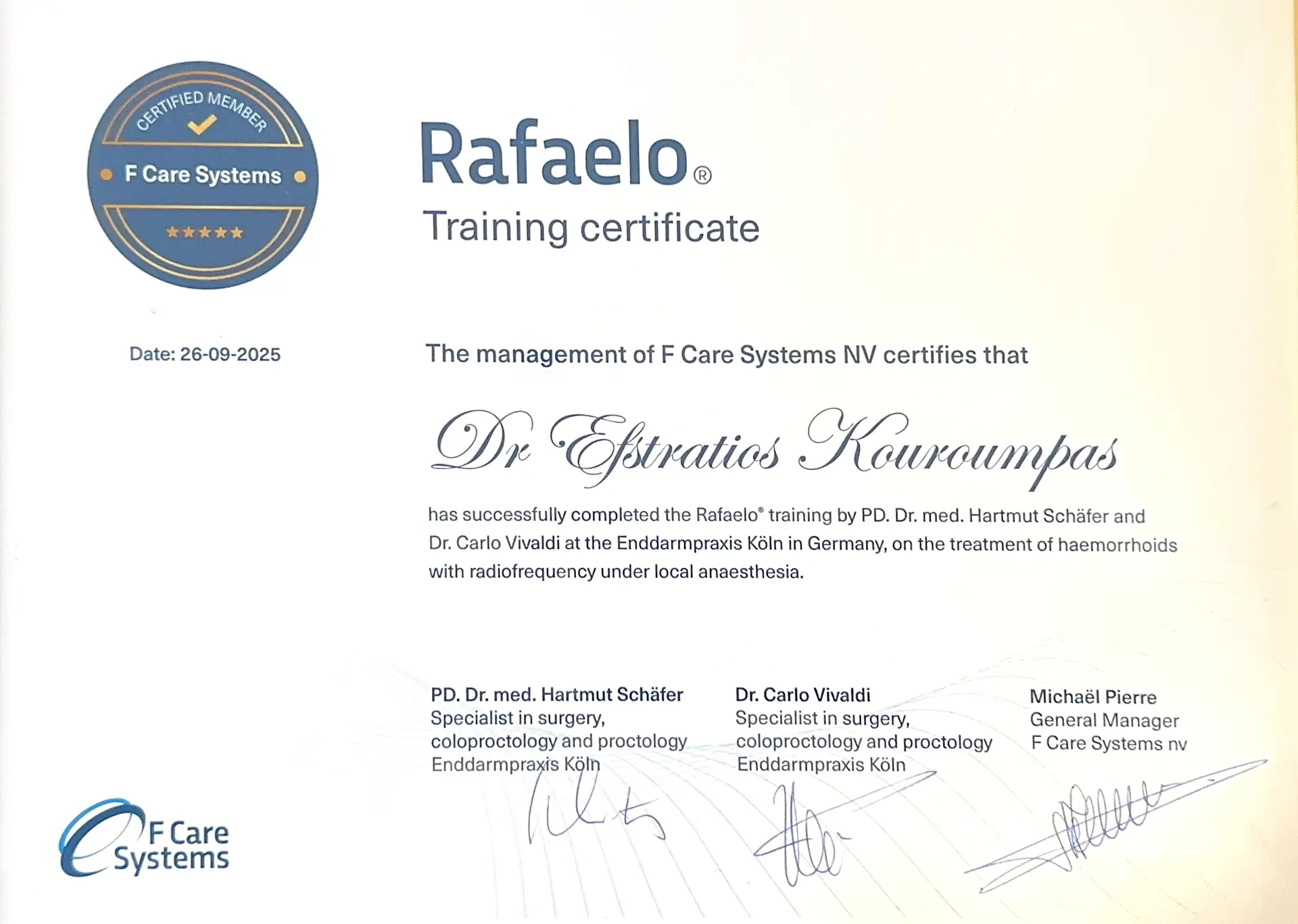
Efstratios K. Kouroumpas completed F Care Systems certified training in radiofrequency treatment of haemorrhoids under local anaesthesia.
Grade mainly describes internal haemorrhoidal prolapse. Bleeding, the external component, thrombosis, continence, previous procedures and patient priorities complete the picture.
Bleeding or discomfort without prolapse outside the anus. Treatment usually begins with conservative care or an office procedure when required.
Prolapse during a bowel movement that reduces spontaneously. Office and tissue-preserving options may be considered.
Prolapse requiring manual reduction. Choice depends particularly on the external component and recovery priorities.
Permanent, irreducible prolapse. Excisional treatment is more often considered after full assessment.
Краткие ответы перед индивидуальной консультацией хирурга.
No. It may offer less short-term pain in appropriately selected internal disease, but it does not address every form of prolapse or a large external component equally well. Selection follows examination.
It is a technique that ablates internal haemorrhoids using controlled radiofrequency energy. It may be performed under local anaesthesia in appropriately selected disease and does not excise anoderm. It is not suitable for everyone, particularly when there is a large external component or very advanced prolapse.
In selected internal haemorrhoidal disease with bleeding and prolapse, particularly when avoiding anoderm excision is a priority. Recurrence risk is balanced against the usual advantage of less early pain.
Excisional haemorrhoidectomy usually has a more demanding early recovery than non-excisional techniques. Structured pain control, bowel regulation and clear care instructions are essential parts of treatment.
Not always. The decision depends on age, history, examination, screening status and warning signs such as anaemia, a change in bowel habit or unexplained weight loss.
Окончательный выбор зависит от клинической картины, анатомии и актуальных рекомендаций.
Информация носит образовательный характер и не заменяет осмотр врача. Риски и альтернативы обсуждаются индивидуально.
На консультации оцениваются симптомы, исследования и альтернативы.
Приём в REA MED и проезд